
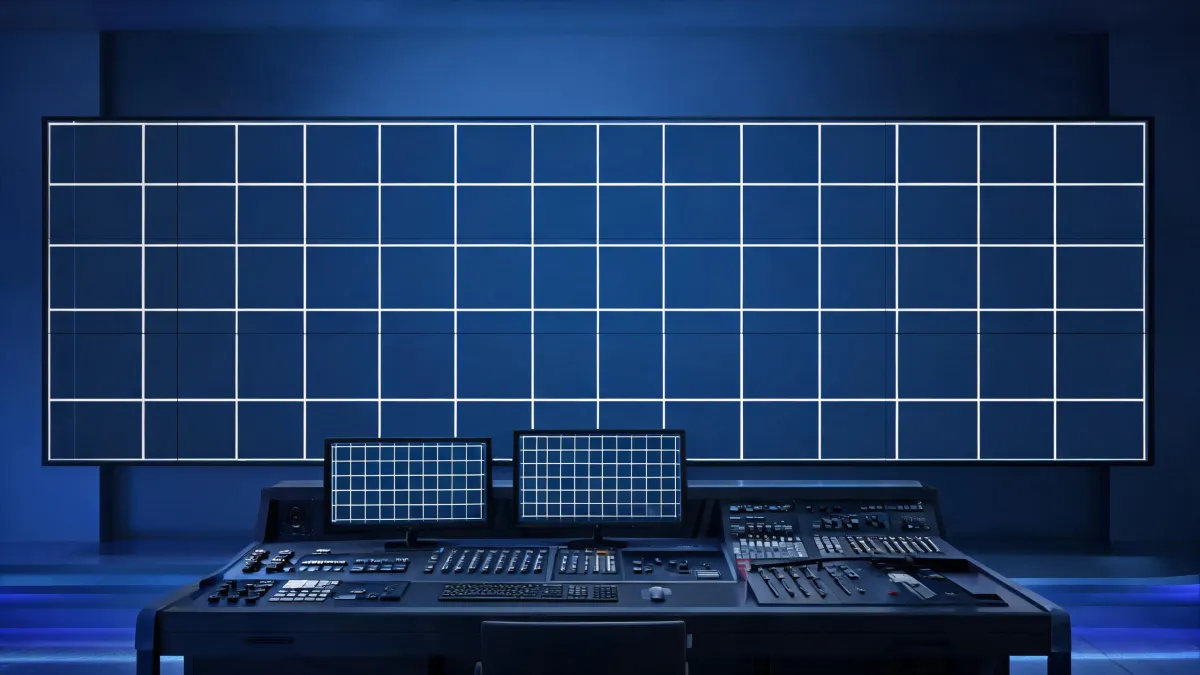
When my VP said we needed 'a video wall for the lobby,' I thought he meant a larger TV. That was in February 2024. By the end of that year—or rather, by November—I had learned more about LED displays, digital signage agencies, and total cost of ownership than I ever expected.
I'm the office administrator for a 200-person company with offices in three cities. I manage all day-to-day ordering—roughly $80,000 a year across eight vendors—and I report to both operations and finance. That means I care about three things: the invoice matches the PO, the internal customer is happy, and my boss doesn't get pulled into a problem that should have been caught earlier.
The request that started it all
The VP wanted something in the lobby 'that looks like a real company.' He had seen something at a conference, but he could not tell me what it was. A video wall? A large LCD monitor? A creative installation with transparent OLED? I had no idea. So I started searching.
Here is where the search problem began. Looking for 'Planar' as a display brand is simple. But search results also turn up 'planar speaker driver,' which is an entirely different audio technology. Then there is 'Rega Planar 1 price France'—a turntable, not a display. Our intern spent half a morning trying to reconcile these and finally asked, 'Are we buying audio and screens from the same company?' No, we were not.
Bringing in the experts
I did not want to repeat that kind of confusion with a meaningful purchase. This project came up during our 2024 vendor consolidation exercise. I was already reducing our vendor list from 14 to 8, mainly because we kept losing invoice visibility. A vendor who could not provide proper invoicing cost us $2,400 in rejected expenses. I did not want a display supplier to become another one of those stories.
So I called three digital signage agencies. One was a national integrator that works with large retailers. One was a two-person studio that focuses on content templates. The third was a firm that showed up when I searched 'digital signage Georgetown'—and they ended up being the most useful.
The Georgetown agency asked questions the other two did not. Who updates the content? How often will the message change? What happens if the processor fails during an event? Do we have an internal owner for the system? I did not have answers. I had been thinking about pixel pitch and brightness. They were thinking about workflows, staff, and failure modes.
The cheap option that wasn't
One of the integrators sent a proposal using Planar video wall tiles. It was not the cheapest proposal, but it was the clearest. Then I made a mistake: I asked for 'something more affordable.' A friend in event production mentioned a contact who could sell us LED mesh screen wholesale pricing. It sounded perfect for a lobby that would occasionally be used for presentations.
The LED mesh screen wholesale option came in about 35% lower than the Planar-based quote. I knew I should ask for a demo and test it in our space. But I was under pressure to have something ready before a board meeting, and I thought, 'What are the odds? It's just a screen.'
In practice, it was not just a screen. The shipping quote arrived with a $450 liftgate fee and a required delivery window. The panels were heavier than the spec sheet said—or to be fair, the spec sheet was for the panels only, not the mounting frame. The image had horizontal bands across the bottom two rows, and the calibration software crashed on Windows 11. We spent four days with contractor help trying to make it usable. Finance did not say much. They simply placed the invoice in the shared folder with a red label. That felt worse than being yelled at.
The turn: Planar, a real integrator, and a demo
After that failure, the Georgetown agency suggested we go back to the integrator who had proposed Planar and arrange a hands-on demo. They brought in a similar Planar model—not the exact one we would buy, but close enough. The difference was visible in the first five minutes. No bands. No control software crash. The integrator adjusted the color profile in 10 minutes and showed me a browser-based scheduling tool.
Then the integrator said something I should have asked earlier: 'If this fails, I can be here tomorrow morning.' That statement was worth more than the price difference.
We bought the Planar display. The price was higher than the LED mesh, but when I added up the failed unit, the wasted labor, the extra shipping, and the hours I spent on support calls, the total cost was lower. Maybe not in the first month. Actually, the first month was painful because we were still paying for the earlier mistake. But over two years, the comparison is not close.
Looking back in 2025
What was best practice in 2020 does not apply in 2025. We used to think of digital signage as 'a screen with a playlist.' Now it is a network of displays, content management, remote diagnostics, and service agreements. Planar has moved into microLED and transparent OLED. LED mesh is no longer just a concert rental product. The fundamentals have not changed: verify the vendor's support model, confirm the invoice structure, get everything in writing. The execution has transformed.
If I were doing this again, I would start with four questions before any pricing:
- Who inside our company owns the content?
- What is the expected service response time for the location?
- Can we test the exact model in our space for at least 48 hours?
- Does the proposal include installation, commissioning, and training?
I would also remember that Planar the display brand, planar speaker driver the audio technology, and Rega Planar 1 price France are separate search problems. It is easy to laugh at that, but for a team without a dedicated AV department, it is a real obstacle.
We kept the Planar wall. Six months later, the VP asked if we could add a second one in the conference room. This time the process took two weeks instead of two months. The right first decision makes everything after it easier.