Office administrator for a 200-person company. I manage all facilities and event AV ordering—roughly $150,000 annually across 12 vendors. I report to both operations and finance. So when someone asks for a new display, I have to think about budget, reliability, and how it fits our spaces.
Most requests come down to two options: a traditional projector or an LED video wall. But there's also the newer 3D hologram fan LED display that pops up for trade shows. And if you're searching for a Rega Planar 1 price USA or a planar magnetic subwoofer, those are audio products—this article is about visual displays.
I've been through three AV upgrades in five years. Here's how I compare these options across the dimensions that actually matter for procurement.
Initial Cost vs. Total Cost of Ownership
When I first started managing AV purchases, I assumed projectors were always the budget-friendly choice. Three bulb replacements later, I realized total cost of ownership tells a different story.
Upfront, a projector setup is cheaper. A good 1080p projector for a conference room might run $800–$1,500. Add a screen, mount, and cables, and you're at $2,000–$3,000. An LED video wall, like those from Planar, starts much higher. A 100-inch active LED display can be $15,000–$40,000 installed, depending on pixel pitch and brightness. I got a quote last year for a 110-inch 1.5mm pitch wall—$28,000 installed.
But then the hidden costs hit. Projector bulbs cost $200–$500 each and last 2,000–5,000 hours. In a room used 8 hours a day, that's a new bulb every 6–12 months. Plus filters, cleaning, and eventual replacement. LED walls have no bulbs, no filters. They last 50,000–100,000 hours. Modular design means you replace a single panel, not the whole unit.
Per FTC guidelines (ftc.gov), advertising claims must be truthful and substantiated. So when a vendor says "zero maintenance," ask for evidence. Nothing is zero maintenance. But LED walls are close.
Over five years, I've calculated that a projector can cost 2–3 times its purchase price in maintenance. An LED wall might cost 10–20% in occasional module swaps. That's the surprise: the expensive option can be cheaper long-term. I ran the numbers for our main conference room. Projector: $2,500 upfront + $1,200 bulbs + $600 cleaning + $800 replacement projector = $5,100 over 5 years. LED wall: $18,000 upfront + $500 module replacement = $18,500. But the LED wall is still going strong at year 5, while the projector is on its third bulb. If we keep the LED wall for 10 years, it's a clear win.
Display Quality and Room Fit
Why does brightness matter? Because conference rooms have windows. A 3,000-lumen projector looks fine in a dark room. In a bright room, it's washed out. An active LED display emits its own light—2,000 nits or more. You can see it from any angle, even with lights on.
Most buyers focus on resolution and completely miss brightness and contrast. For a typical meeting room, contrast matters more than 4K. LED walls have perfect blacks because pixels turn off. Projectors create gray "blacks" because the lamp is always on.
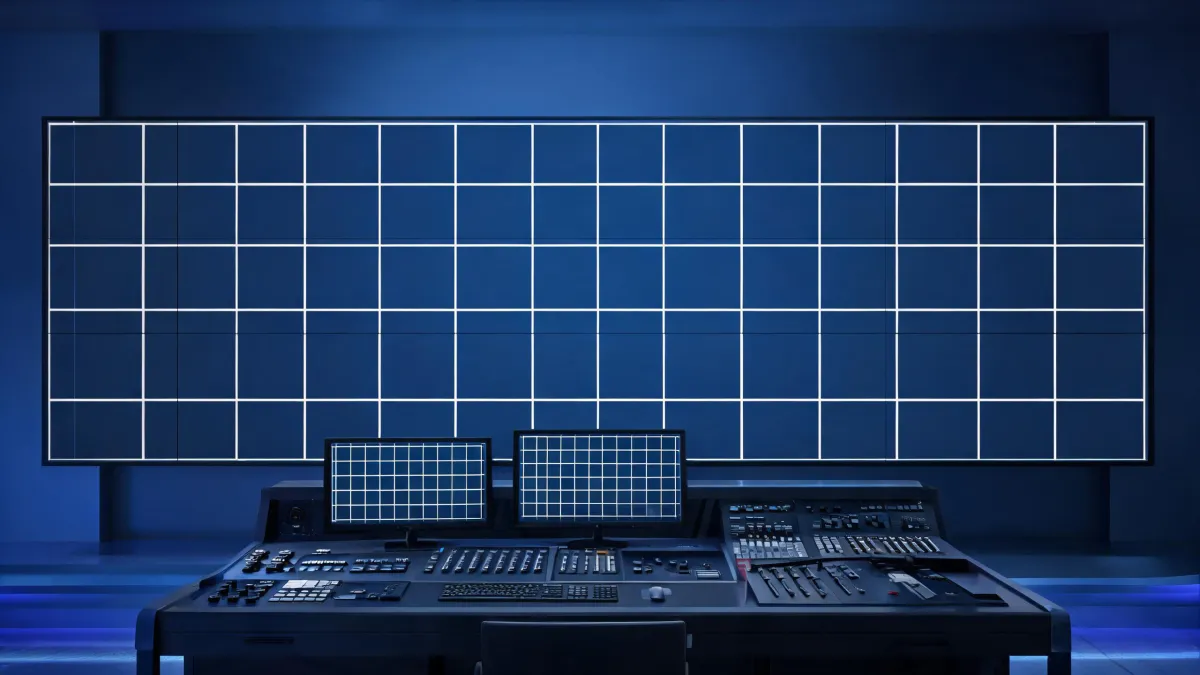
For a dedicated LED screen room—like a control room or a high-end lobby—LED walls are unbeatable. They're seamless, bezel-free, and can be any shape. Projectors need distance and alignment. I've seen a 180-inch LED wall in a lobby that curves around a corner. You can't do that with a projector without multiple units and blending software.
The 3D hologram fan LED display is a different animal. It's a spinning LED fan that creates floating images. Great for trade show booths or retail windows. Not great for reading text or detailed charts. I've used one for a product launch—it drew a crowd. But I wouldn't use it for a quarterly review. The resolution is limited, and the image is only visible from certain angles.
Maintenance and Reliability
Projectors have moving parts: fans, color wheels, lenses. They collect dust. They overheat. They need lamp replacements. LED walls have no moving parts. The main failure point is the power supply or a single LED module. Replacing a module takes 10 minutes with a suction tool.
I had a projector die mid-presentation. The CEO was not happy. That's when I started looking at LED. Our Planar wall has been running for 18 months with zero issues. But I should note: we only have three rooms with LED walls. The rest still use projectors. That said, for mission-critical spaces, LED wins.
Short sentence: No bulbs. No filters. Just pixels.
But reliability isn't just hardware. It's also content management. LED walls often need a dedicated processor and content management software. Projectors just take an HDMI cable. That's an extra cost and training burden. So factor in the cost of a video processor and someone to manage it.
Flexibility and Installation
Look, I'm not saying projectors are useless. I'm saying they have a time and place. If you need a portable display for different rooms, a projector wins. It fits in a bag. An LED wall is fixed. You install it once and it stays.
Installation complexity: Projector—easy. Mount, align, done. LED wall—requires a structural assessment, power, and a professional integrator. It's a construction project. For a temporary event, a 3D hologram fan LED display is easier to move. But it's also limited in size and resolution.
For a permanent LED screen room, the installation is a one-time pain. Then you forget about it. For a projector, you're always adjusting keystone, focus, and cables. I've spent hours troubleshooting a flickering HDMI cable. Not fun.
Which Should You Choose?
Here's my decision framework from five years of procurement:
- Choose a projector if: Your room is dark, your budget is under $5,000, you need portability, and you don't mind replacing bulbs every year.
- Choose an LED video wall if: You have a bright room, you need a professional permanent installation, you want low maintenance over 5+ years, and you can invest $15,000+ upfront. Brands like Planar offer reliable options for control rooms and lobbies.
- Choose a 3D hologram fan LED display if: You need an eye-catching attention grabber for a trade show or retail window. It's a supplement, not a primary display.
An informed customer asks better questions and makes faster decisions. So ask vendors about total cost of ownership, brightness in nits, and maintenance schedules. Don't just ask for the lowest price.
I'd rather spend 10 minutes explaining options than deal with mismatched expectations later. That's why I write guides like this. Help me help you—so we both look good to the VP.