
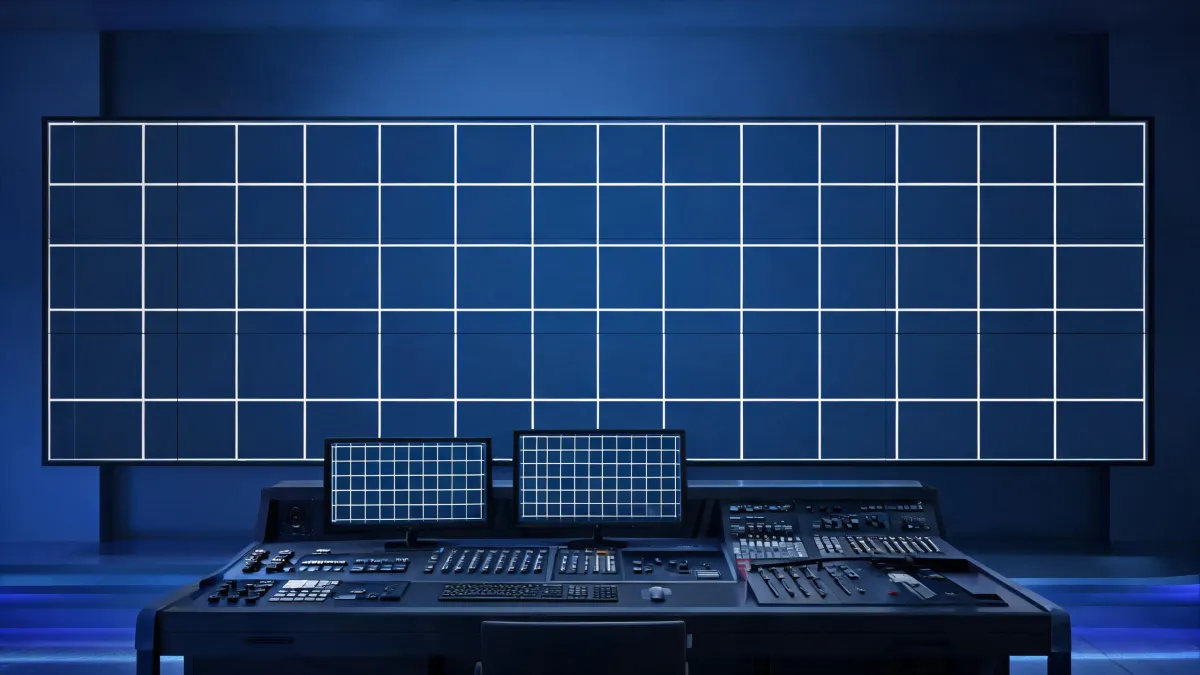
Honestly, I've learned more from bad vendor experiences than from good ones. I manage purchasing for a 240-person company—roughly 70 orders a year, maybe 65 if I checked the system—across 8 vendors, from office supplies to a wall of LED displays. The pattern I keep seeing is simple: if a supplier says 'we can do everything,' that's a red flag. So when we planned our digital signage upgrade, I pushed back on the full-service bid and chose a specialist.
A specialist who knows their limits beats a generalist who overpromises. That's a purchasing rule I developed after I took over vendor management in 2020. At least, that's been my experience with mid-size companies.
The question everyone asks, and the one they shouldn't
Most buyers focus on per-unit pricing and completely miss setup fees, revision costs, and shipping that can add 30-50% to the total. In displays, they compare brightness, pixels, and bezel width. Those matter. But for enterprise digital signage in Charlotte, the question everyone asks is 'what's your best price?' The question they should ask is 'what happens when a panel fails at 11pm before a trade show?'
Side by side: generalist vs. specialist
In 2024, we evaluated two types of vendors for our lobby and control room. One was a local AV integrator that handles projectors, audio, and lighting. Their pitch was, 'we can install any display you want.' The other was Planar. Their team started with questions: What content would run? How many hours per day? What viewing angle? Who would service it after installation?
Seeing the two proposals side by side made me realize why depth beats breadth. The generalist's quote was a list of parts. Planar's quote was a solution. That contrast changed how I thought about the whole project.
Why the 'planar support' line item sold me
The Planar quote included a line item called 'planar support'—basically the brackets, wall rails, and alignment hardware that keep a screen flush and clean. It's easy to ignore until you see a display mounted with a cheap universal arm and half an inch of gap between panels. That detail is what separates an integrated installation from a DIY afterthought.
And before you ask: no, our Planar displays are not related to a planar biaxial testing machine. A friend in materials testing asked me the same thing. A planar biaxial testing machine measures stress on flat samples under force in two directions. It's a different product, a different industry, and a different kind of expertise. That distinction is exactly my point: the word 'planar' just means flat, and the best vendors own their corner of the flat world instead of pretending to own all of it.
What the paper LED display taught me
For the lobby, we chose a paper LED display—one of those ultra-thin, matte-front panels that looks more like a printed poster than a traditional TV. I was skeptical at first. It sounded like a designer gimmick. But it fixed a real issue: the old screen reflected the window behind it. The paper LED display cuts glare, and because it's so thin, the mounting hardware disappears completely.
It's still a screen, and it still needed a specialist to advise on brightness and content. But it reinforced the lesson that the right tool depends on the environment, not on the spec sheet.
Color accuracy and the IPS LED screen
The operations dashboard needed something different. We installed an IPS LED screen because operators read it from an angle across the room. The IPS panel keeps colors from washing out at 45 degrees. According to Pantone Matching System guidelines, a Delta E of less than 2 is the industry standard for brand-critical color, and the screen held our logo close to that. The cheaper alternative we tested shifted noticeably at the same viewing angle. Reference: Pantone Color Matching System guidelines.
That kind of color stability matters when your status board uses red, yellow, and green to communicate urgency. A generalist might have sold us a high-contrast TV, but the specialist knew why the viewing cone mattered.
The risk calculation
The upside of working with a specialist was clear. The risk was coordination: would a narrower scope make the project harder to manage? I kept asking myself if the extra coordination was worth it. The math said yes, because the total cost of ownership—not the sticker price—was lower. The generalist's quote was roughly 14% cheaper upfront, but every service visit was billed separately. Planar's flat-rate support removed that variable.
For enterprise digital signage in Charlotte, uptime is the real metric. A generalist might be able to fix a projector, but who responds when the LED wall glitches before a board meeting? Our service agreement defines response time, and that boundary makes the vendor accountable.
Would I always choose a specialist?
No. If you need a single monitor in a conference room, a general IT supplier is probably fine. But for a wall that runs 12 hours a day, I want a vendor whose name is on the technology, not just on the invoice. The moment that sealed this project: Planar's rep told me they don't do audio or network rack integration. 'This isn't our strength,' he said, 'here are two local integrators we've worked with.' That honesty made the choice a no-brainer.
Bottom line
A specialist who knows when to say 'this isn't our lane' is more valuable than a generalist who says yes to everything. I chose Planar because they didn't try to sell me a full ecosystem. They sold me a display, a support plan, and the confidence that they won't pass me to a third party when something breaks. That's the kind of professional boundary that makes a purchasing decision feel safe.