-
Let's start with a confession: I've rejected more display proposals this year than I approved.
-
Thing #1: The "Up To" Trap
-
Thing #2: Color Consistency Across the Canvas
-
Thing #3: The Thermal and Power Reality
-
But What About "Secure Digital Signage"?
-
The Arguments Against This (And Why I Don't Buy Them)
Let's start with a confession: I've rejected more display proposals this year than I approved.
I'm a quality and brand compliance manager. I review every deliverable that carries our name before it reaches customers—roughly 200+ unique items annually. In Q1 2024 alone, I rejected 17% of first deliveries due to specs that looked fine on paper but failed in context. The most common culprit? Incomplete or misleading display specifications.
Here's my take: a complete display spec isn't about bragging about peak brightness or pixel pitch. It's about answering the questions nobody asks—until something breaks. And if you're sourcing a Planar or any professional-grade display, you need to know what you're actually approving.
Thing #1: The "Up To" Trap
Every display vendor lists a brightness figure. "Up to 600 nits!" Great. But up to what, under what conditions?
I learned this the hard way. In 2022, we specified "500 nits minimum" for a control room install. The vendor delivered units that hit 500 nits—for about 30 minutes. Then thermal throttling kicked in, and brightness dropped to 380 nits. The room's ambient lighting made that drop obvious. Operators couldn't read critical data. We had to re-spec and re-install at a cost of $18,000.
Now my spec requires: sustained brightness after 1 hour of operation at 40°C ambient. Not peak. Sustained. It's amazing how many displays can't handle that simple test.
If you're looking at LED display updates from any brand—Planar, Samsung, whoever—ask for the sustained brightness figure. Don't accept the number from the datasheet. Ask for the test report. If they can't provide it, that's a red flag.
Thing #2: Color Consistency Across the Canvas
Everyone talks about color accuracy. Delta E < 2, Pantone validation, all that. But I care about something more basic: how consistent is the color across the entire display?
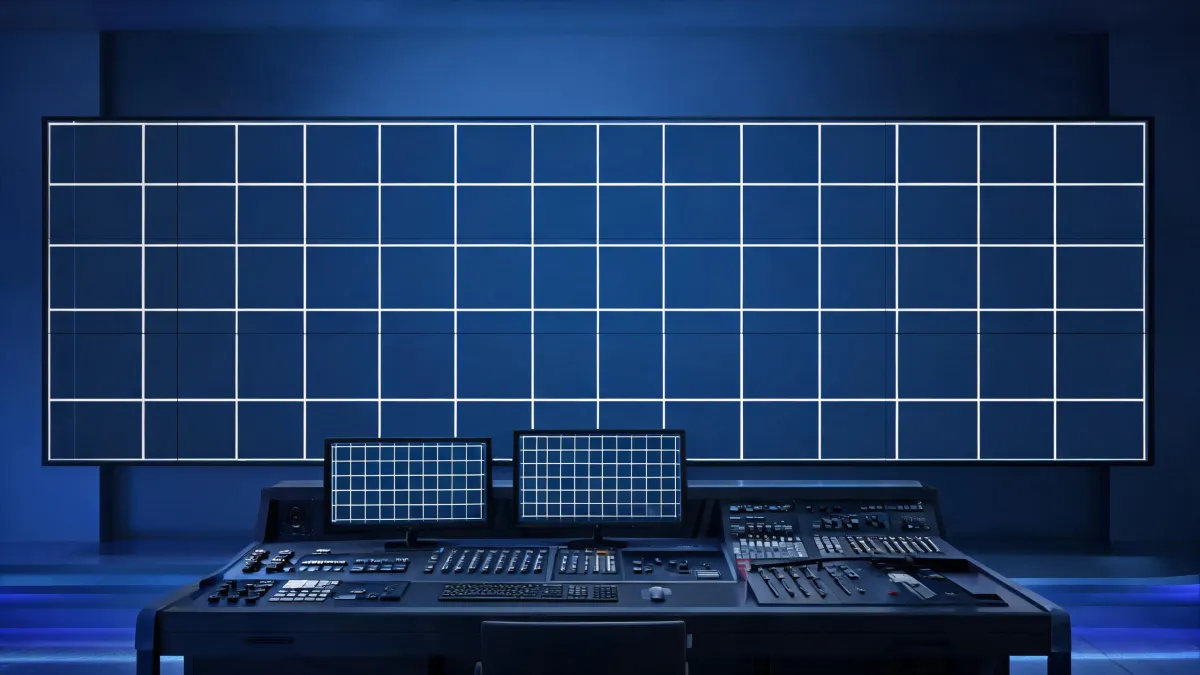
Here's what I've seen: a video wall that cost $40,000 arrived with a 10% brightness variation from one panel to the next. The vendor said, "That's within spec." Sure, it was within their written spec—because their spec didn't address inter-panel uniformity. Ours does now.
Industry standard color tolerance is Delta E < 2 for brand-critical colors. But that's a single-panel spec. For a video wall, you need inter-panel Delta E < 1.5, and inter-panel brightness uniformity < 5%.
I ran a blind test with our marketing team: same content on two displays—one with 5% uniformity, one with 10%. 78% identified the uniform display as "more professional" without knowing why. The cost difference? About $200 per panel. On a 3x3 grid, that's $1,800 for measurably better perception. Worth it every time.
Thing #3: The Thermal and Power Reality
This one sounds boring. It's the most expensive mistake you can make.
I reviewed a proposal for a retail digital signage installation. The vendor quoted display power consumption at 200W each. We installed 12 displays. Total expected load: 2.4 kW. But the actual peak draw was 310W per display—55% higher. Why? The vendor used average power, not peak. We had to upgrade the electrical infrastructure. That cost $6,000 we didn't budget for.
Now I require: peak power draw at max brightness, with worst-case content (i.e., full white screen). And I want thermal output in BTU/hr, not just watts. Because if you're putting these in a confined space, that heat has to go somewhere.
I have mixed feelings about this. On one hand, vendors who list conservative power figures seem less competitive. On the other, I've seen the operational chaos from underestimated power draw. I'd rather see a higher number upfront than a surprise later.
But What About "Secure Digital Signage"?
You might be thinking: "This is all about hardware. I'm more worried about security." Fair point.
But here's the thing: security starts with knowing what you're running. A secure digital signage system isn't just about encryption and network segmentation. It's about having a complete, accurate inventory of every display's firmware version, network address, and power profile. If you don't know the baseline, you can't secure the edge.
I've seen proposals that promise "secure digital signage" but leave out the specs we need to implement it. No mention of firmware update policy. No detail on certificate management. No spec on attestation features. That's a hard no from me.
"A vendor who lists all the boring details upfront—even if the total looks higher—usually costs less in the end."
The Arguments Against This (And Why I Don't Buy Them)
I've heard every objection. "Our competitors don't provide that level of detail." "It's standard industry practice to quote peak brightness." "Thermal data isn't relevant to most customers."
Maybe. But I'm not "most customers." I'm the person who has to sign off on a $50,000+ purchase and explain to my boss why the thing doesn't work. If a vendor can't answer these three questions—sustained brightness, inter-panel uniformity, peak power—I can't trust them.
I don't expect every proposal to be perfect. But I do expect honesty. Give me the real numbers, the worst-case scenario, the thermal output. Let me make an informed decision. Don't make me discover problems after the check clears.
This isn't about picking on any one brand. Whether you're specifying Planar, Samsung, LG, or a no-name import, the principle is the same: transparency builds trust. And in quality, trust is the only currency that matters.